
Peking duck: what it is, how to make it and how to eat it
From the imperial kitchens of Beijing to your own oven: everything about the most famous duck dish in the world. With its history, the secret of the crispy skin, a recipe to make at home and where to eat Peking duck in three courses in Amsterdam.
In short
Peking duck is a Chinese dish from Beijing: a whole duck that is inflated, glazed and dried, then roasted hanging until the skin is glossy and crisp. You eat the skin and meat rolled in thin pancakes with spring onion, cucumber and sweet bean or hoisin sauce. In a traditional restaurant this is followed by a soup made from the carcass and a dish with the rest of the meat: Peking duck in three courses.
On this page: What is Peking duck? · History · The secret of the crispy skin · How to eat Peking duck · Recipe for home · Making the pancakes · Buying Peking duck · Where to eat it · FAQ
What is Peking duck?
Peking duck is one of the best-known dishes of Chinese cuisine. It is a whole roasted duck with a thin, glossy and very crisp skin over juicy meat. The dish comes from Beijing, which used to be called Peking in the West, hence the name.
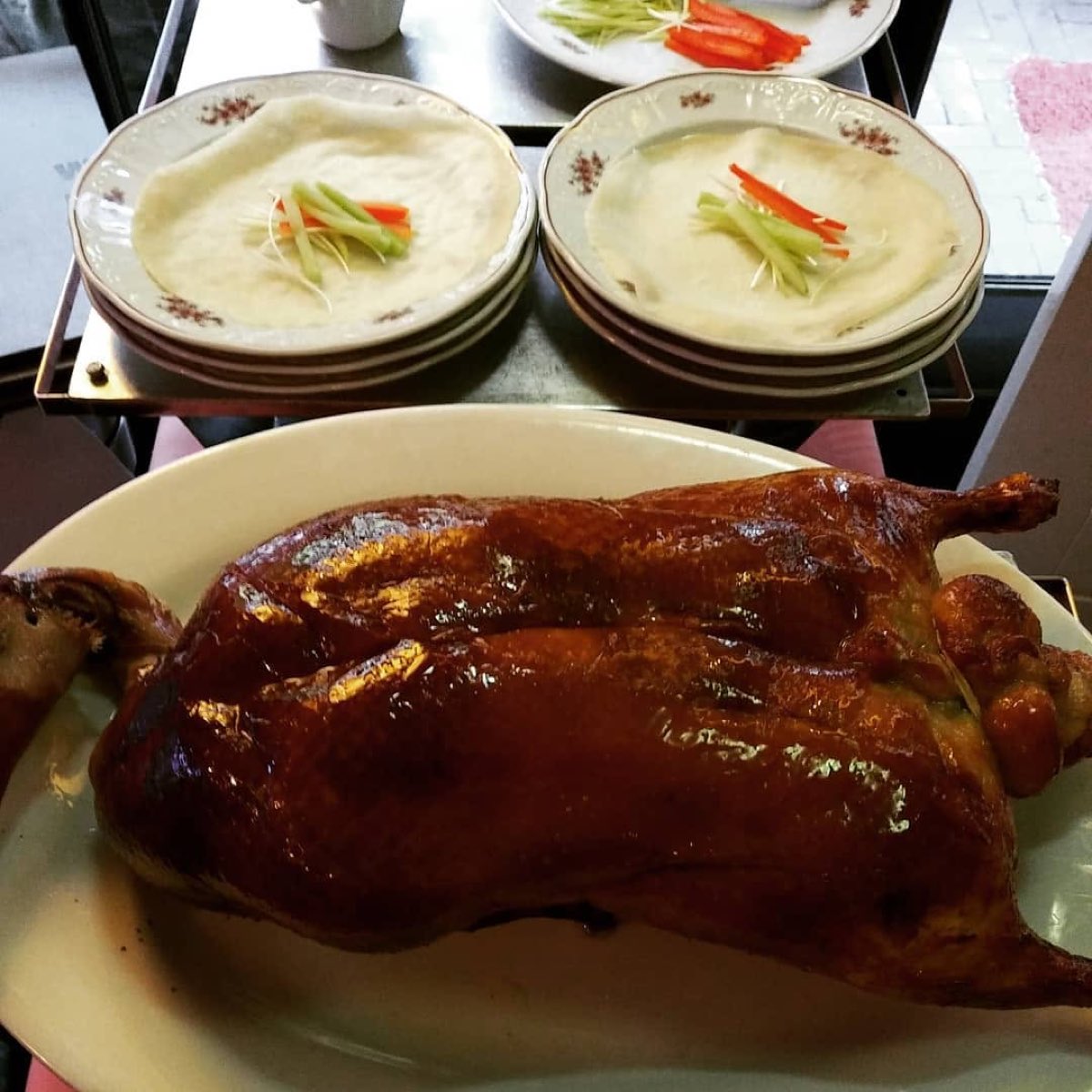
What sets Peking duck apart from an ordinary roast duck is the preparation. The duck does not simply go into the oven: the skin is separated from the meat, scalded, glazed with a sugary coating and dried for hours. Only then is it roasted. The result is a skin that crackles almost like a thin layer of glass.
What kind of duck is a Peking duck?
Pekin is not only the name of the dish but also of a breed: the white Pekin duck, a domesticated descendant of the mallard. The breed was raised in China to grow quickly and to develop a good layer of fat under the skin, exactly what you need for a crisp skin. In Europe and North America the Pekin is also one of the most common meat ducks.
What is the difference between roast duck and Peking duck?
Roast duck is any duck cooked in the oven. Peking duck is a specific method from Beijing, with the characteristic glazed, crackling skin and the way it is served in pancakes. A pan-fried duck breast or a duck confit is duck, but not Peking duck. Cantonese roast duck is a close relative, but it is usually seasoned inside and served chopped, without pancakes.
The history of Peking duck
Roast duck was served at the Chinese imperial court centuries ago. When the capital moved to Beijing under the Ming dynasty in the fifteenth century, the dish moved with it and the city grew into the centre of duck cooking. Restaurants such as Bianyifang (dating back to the Ming era) and Quanjude (founded in 1864) made the duck famous with a wide public in the nineteenth and twentieth centuries.
There are two classic roasting methods. In the closed oven, the older method, the duck is roasted with indirect heat. In the open oven the duck hangs above a fire of fruitwood, which gives the skin a light, smoky flavour. Both methods are still used today.
Today Peking duck is a dish loved around the world and a fixture of festive tables, especially around Chinese New Year. In the Netherlands it became known partly through Chinese restaurants that kept serving it the traditional way, such as Sichuan Food in Amsterdam, once the first Chinese restaurant in the Netherlands to earn a Michelin star.
The secret of the crispy skin
The crispy skin is what Peking duck is all about. It is not the result of high heat alone, but of a series of steps that make the skin dry and thin and let the fat underneath melt away:
- Air under the skin. Traditionally, air is blown between the skin and the meat. This separates the skin so the fat can drain away during roasting.
- Scalding. The duck is doused with boiling water. The skin contracts and tightens.
- Glazing. The skin is brushed with a glaze of maltose syrup (or honey), often with a little vinegar. This gives the deep mahogany colour and helps the skin crackle.
- Drying. The duck is then hung to dry for hours, up to a full day, in a cool and airy place. The drier the skin, the crispier the result.
- Roasting hanging. Hanging in the oven, the duck roasts evenly on all sides and the fat drips away freely.
So a crispy skin starts a day before the duck goes into the oven. That is why good restaurants often ask you to order Peking duck in advance.
How to eat Peking duck
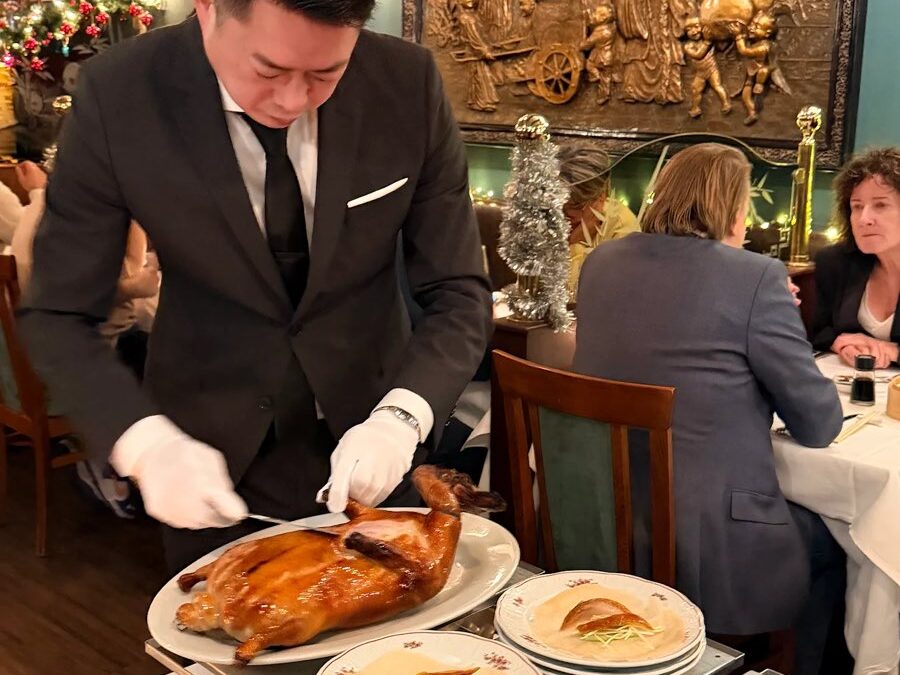
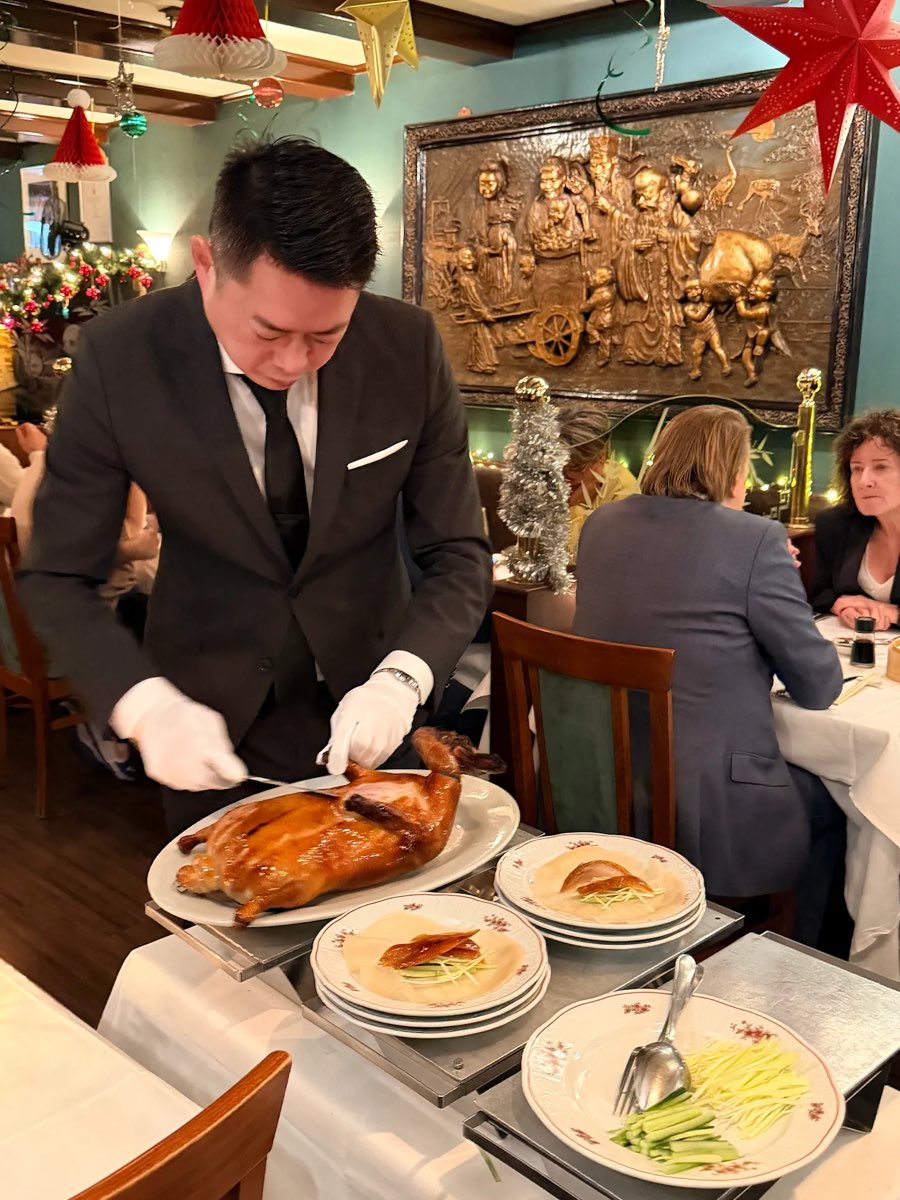
The duck is carved at the table or just before serving, first the skin and then the meat in thin slices. This is how you eat it:
- Place a thin pancake flat on your plate.
- Spread a little sweet bean sauce or hoisin sauce on it.
- Add a piece of crispy skin and a slice of meat.
- Add strips of spring onion and cucumber.
- Roll or fold the pancake and eat it with your hands.
Some connoisseurs dip the very first piece of skin in a little sugar, an old Beijing custom to taste its pure crispness.
Peking duck in three courses
In the traditional restaurant kitchen nothing of the duck goes to waste. That is why Peking duck is often served in three courses: first the skin in pancakes, then a clear broth made from the carcass, and finally the rest of the meat in one or more hot dishes. Read exactly how it works in Peking duck in three courses: how the tradition works.
Peking duck recipe for home
Making a true restaurant-style Peking duck, with air under the skin and a hanging oven, is hard at home. With the recipe below you get remarkably close in a regular oven. Allow a day for drying.
Serves 4 · preparation 30 minutes · drying 24 hours · oven time about 1.5 hours
Ingredients
- 1 whole duck of 2 to 2.5 kg (ideally Pekin), thawed
- 2 tablespoons maltose syrup or honey
- 1 tablespoon rice vinegar
- 1 tablespoon light soy sauce
- 1 teaspoon five-spice powder
- 1 teaspoon salt
- 3 spring onions and a thumb of ginger, in pieces
- To serve: 16 to 20 pancakes, 1 cucumber and 4 spring onions in strips, sweet bean sauce or hoisin sauce
Method
- Prepare. Pat the duck dry and remove excess fat around the cavity. Rub the inside with salt, five-spice and soy sauce and put the spring onion and ginger inside. Close the opening with a skewer.
- Scald. Place the duck in a colander in the sink and slowly pour a full kettle of boiling water over it, all around. The skin tightens immediately.
- Glaze. Dissolve the maltose or honey in the vinegar and 2 tablespoons of hot water. Brush the entire skin with it.
- Dry. Place the duck uncovered on a rack in the fridge for at least 12 and preferably 24 hours. The skin should feel like parchment.
- Roast. Preheat the oven to 200 °C (390 °F). Place the duck breast side up on a rack over a drip tray with a little water. Roast for 20 minutes, then lower to 170 °C (340 °F) and roast for about 60 minutes more. Turn the oven up to 220 °C (430 °F) for the last 10 minutes for extra crispness. Keep an eye on the skin and cover any parts that darken too quickly with a little foil.
- Rest and carve. Let the duck rest for 10 minutes. Carve the skin into pieces first, then slice the meat thinly.
- Serve. Warm the pancakes briefly in a steamer and serve with the sauce, spring onion and cucumber.
Tip: simmer the carcass into a broth with ginger, spring onion and some Chinese cabbage. That way you also make the second course of the tradition at home.
How to make Peking duck pancakes
The thin pancakes, also called Mandarin pancakes, need only three ingredients:
- Mix 250 g plain flour with about 175 ml boiling water into a dough. Once slightly cooled, knead for 5 minutes until smooth and let it rest covered for 30 minutes.
- Roll the dough into a log and cut it into 16 to 20 equal pieces. Flatten them.
- Brush half of the rounds with a little sesame oil and place a second round on top. Roll out each pair into a thin pancake of about 15 cm.
- Cook them in a dry frying pan over medium heat, about 30 seconds per side, until light bubbles appear. Pull them apart straight away: you now have two paper-thin pancakes.
- Keep them warm under a clean tea towel or in a steamer.
Buying Peking duck
If you would rather not start with a raw duck, Asian supermarkets and some butchers or online shops sell a ready-cooked or frozen Peking duck, often with pancakes and sauce. You simply reheat it in the oven. It is convenient, but the skin is rarely as crisp as a freshly roasted duck. For the real experience, a freshly roasted duck in a restaurant remains unbeatable.
Where to eat Peking duck in Amsterdam
At Sichuan Food in the heart of Amsterdam (Reguliersdwarsstraat 35, close to Rembrandtplein) Peking duck has been the house speciality for decades. It is served in three courses: the crispy skin rolled in pancakes, then a duck broth and finally the meat prepared in three ways. The dish can be ordered from two people, at € 63.50 per person. Mention when you book that you would like the Peking duck, so it is ready for you.
Want to compare places? Read our guide where to eat the best Peking duck in Amsterdam.